
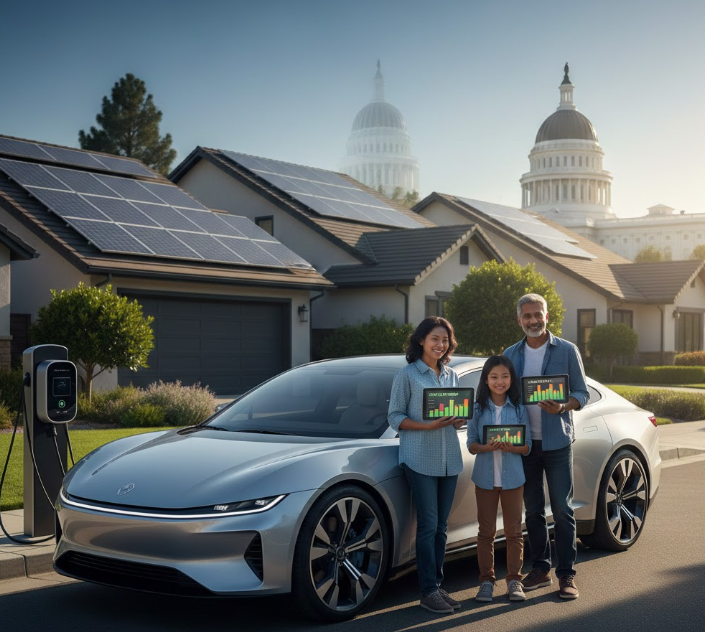
With the termination of the federal EV tax credit (IRA) on September 30, 2025, California has proactively stepped in, allocating state funds to establish its unique incentive structure. This guide is a skyscraper report, meticulously detailing every available benefit for California residents in 2026.
1. Strategic Context: California’s Policy Divergence from Federal Government
The U.S. electric vehicle market reached an unprecedented turning point in 2026. The federal government’s “One Big Beautiful Bill” legislated the discontinuation of the crucial $7,500 EV tax credit from the Inflation Reduction Act (IRA), sending shockwaves through the automotive sector. However, Governor Gavin Newsom of California, steadfast in pursuing the state’s “2035 ban on new internal combustion engine vehicle sales,” has earmarked $200 million for new Zero-Emission Vehicle (ZEV) incentive programs in the 2026-27 fiscal year.
According to a recent energy transition analysis by Goldman Sachs, California’s decisive action underscores its commitment to strengthening its economic independence as a “Green State,” directly countering federal policy shifts. For consumers, this means shifting focus from federal tax credit timing to leveraging state-level instant discounts (Point-of-Sale) combined with local utility rebates to immediately reduce the purchase price.
2. 2026 California EV Incentive Breakdown: A Layered System
California’s 2026 incentive system is far more sophisticated than a simple rebate. Benefits are now multi-layered, contingent on income levels, residency, vehicle trade-in status, and even the electric utility provider.
2.1 The New California Rebate Program (Proposed 2026 Program)
This program is designed to mitigate a potential slowdown in EV sales following the cessation of federal benefits.
- Support Mechanism: Offers instant discounts (on-the-hood) directly at the dealership at the time of purchase.
- Eligibility: Individuals purchasing or leasing new Battery Electric Vehicles (BEVs) or Plug-in Hybrid Electric Vehicles (PHEVs) within California.
- Key Debate: Ongoing political discussions about potentially excluding dominant market players like Tesla from eligibility mean that checking the latest California Air Resources Board (CARB) announcements before making a brand decision is crucial.
2.2 Clean Cars 4 All (CC4A) – Trade-in Linked Program
This program offers the most substantial benefits, specifically targeting residents in disadvantaged communities with poor air quality.
- Strategy: Provides up to $12,000 for trading in an older gasoline-powered vehicle (pre-2009 model year) towards an EV. An additional $2,000 is available for home charging infrastructure.
- Eligibility: Households with income at or below 300% of the Federal Poverty Level (FPL).
2.3 Local Utility Rebates (Utility-Based Incentives)
Electric utility companies actively encourage EV adoption to manage grid load and offer their own distinct rebates.
- SCE (Southern California Edison): Operates a “Charge Ready” program offering up to $4,000 in rebates for used EV purchases.
- PG&E (Pacific Gas & Electric): Provides rebates for used EV purchases for low-income households and offers up to 100% reimbursement for charging equipment installation.
- LADWP (Los Angeles Department of Water and Power): Supports LA residents with up to $1,000 for home charging station installation costs.
3. Technology Solutions & Energy Source Comparative Analysis
EV incentive amounts are not solely based on price; the state’s encouragement varies by energy efficiency and technological type. The state prioritizes Battery Electric Vehicles (BEVs) for their zero-emission footprint.
[Table 1] Vehicle Type vs. Incentive Level & Economic Efficiency (2026)
| Technology Type | Incentive Level | Operating Cost (per mile) | Recommended Driving Pattern | Example Models |
| Battery Electric Vehicle (BEV) | Highest | Approx. $0.04 – $0.06 | City driving & regular commuting | Hyundai IONIQ 5, Kia EV6, Tesla Model 3 |
| Plug-in Hybrid Electric Vehicle (PHEV) | Mid | Approx. $0.08 – $0.12 | Long-distance travel & range anxiety | Hyundai Santa Fe PHEV, Toyota RAV4 Prime |
| Fuel Cell Electric Vehicle (FCEV) | Special | Approx. $0.20+ (high fuel cost) | Residents near hydrogen infrastructure | Hyundai NEXO, Toyota Mirai |
[Table 2] In-depth Pros & Cons of Incentive Programs
| Program | Advantages | Disadvantages | Strategic Advice |
| CA State Rebate | Instant discount at dealer | Strict income limitations (around $100k) | Apply early in the quarter before funds deplete |
| Clean Cars 4 All | Substantial benefits (up to $14,000+) | Requires trade-in of pre-2009 vehicle | Ideal for owners of older, high-polluting cars |
| Utility Rebate | Generous for used EVs | Varies significantly by electric company | Verify coverage based on your utility bill |
4. Money Makes Honey Exclusive Strategy: The “3-Tier Stacking” Method
With federal benefits eliminated, the most intelligent strategy to minimize costs involves a 3-tiered stacking approach.
- Foundation Tier: Secure the new California State Rebate (ranging from $2,000 to $7,500) as an instant discount off the vehicle price.
- Acceleration Tier: Trade in an older, pre-2009 vehicle through Clean Cars 4 All to gain an additional credit of up to $12,000.
- Infrastructure Tier: Immediately after vehicle registration, apply to your utility provider (SCE or PG&E) for a “charging station rebate.” Crucially, the federal charging equipment tax credit ($1,000) is set to expire on June 30, 2026, so prioritize this installation before the deadline.
Market Insight Note: The California Legislative Analyst’s Office (LAO) forecasts that the 2026 EV budget will be exhausted earlier than previous years, as pent-up demand, previously supported by federal incentives, now funnels directly into state programs.
5. Detailed Application Process (Step-by-Step)
Step 1: Prepare Income Verification Documents (IRS Tax Transcript)
The 2026 state rebates are based on your “Modified Adjusted Gross Income (MAGI).” For a household of four, an income at or below $93,600 (300% of FPL) typically qualifies for maximum benefits.
Step 2: Confirm Eligible Vehicle List
Visit the California Air Resources Board (CARB) website to ensure your desired EV model is currently on the list of eligible vehicles. New regulations for 2026, including battery recycling requirements, might temporarily suspend eligibility for some imported models. The Manufacturer’s Suggested Retail Price (MSRP) should not exceed $45,000 for sedans and $60,000 for SUVs.
Step 3: Apply for Pre-Approval
Crucial: Programs like Clean Cars 4 All require pre-approval BEFORE purchasing the vehicle. Buying the car beforehand will make you ineligible for the rebate.
Step 4: Finalize Dealership Agreement
Ensure the rebate is transparently deducted from the vehicle price. If leasing, verify that the incentive is reflected as a “Capitalized Cost Reduction” to lower your monthly payments.
6. [California EV Incentives] Verification Checklist
Before taking action, ensure every item on this list is confirmed to avoid potentially losing thousands of dollars.
- [ ] Residency Requirement: Can you prove California residency for the past 12 months with utility bills?
- [ ] Trade-in Eligibility: Is your trade-in vehicle a pre-2009 model and registered in your name for at least two years?
- [ ] Retention Obligation: Are you prepared to own/lease the EV for at least 30 months within California after receiving the rebate? (Early sale may require pro-rated repayment).
- [ ] Charging Infrastructure: Do you have a Level 2 charger at home or work? If not, do you qualify for utility-sponsored charging installation rebates?
- [ ] No Double-Dipping: Have you confirmed that the programs you plan to stack are not mutually exclusive?
7. Frequently Asked Questions (People Also Ask)
Q1: Is the federal $7,500 rebate gone forever?
A1: Yes, according to current legislation, vehicles purchased after September 2025 are ineligible for the federal tax credit. California’s new $200 million state budget aims to fill this void.
Q2: Will Tesla Model 3s be ineligible for California rebates?
A2: During 2026 budget discussions, some political factions proposed excluding Tesla due to its dominant market share. Always verify specific model eligibility on the final CARB list.
Q3: Can I get a rebate for a used EV bought from a private seller?
A3: No. Most official state and utility rebates apply only to transactions conducted through a licensed dealership.
Q4: Will home charging station incentives also end in 2026?
A4: The federal “Alternative Fuel Vehicle Refueling Property Tax Credit” is set to expire on June 30, 2026. Prioritize installation before this deadline to claim federal benefits.
Q5: Are non-permanent residents (e.g., H1B, F1 visa holders) eligible?
A5: Yes, if you can prove California residency and fulfill tax reporting obligations as a California tax resident, you are generally eligible, provided you meet the income requirements, regardless of immigration status.
8. EV Market Outlook & Strategic Conclusion in 2026
California’s EV policy is evolving from universal support to a focus on “the integration of energy efficiency and residential environments.” The federal government’s policy rollback has, paradoxically, incentivized California to offer more aggressive instant incentives.
Therefore, do not focus solely on vehicle price discounts. By combining EV incentives with California’s solar panel rebates and home Energy Storage System (ESS) installation benefits (like Powerwall), you can potentially reduce your EV charging costs to near zero. As Morgan Stanley’s reports suggest, future asset value will increasingly stem from an “energy-independent residential environment.”
1 thought on “2026 California EV Incentives: Guide After Federal Rebate Termination”