
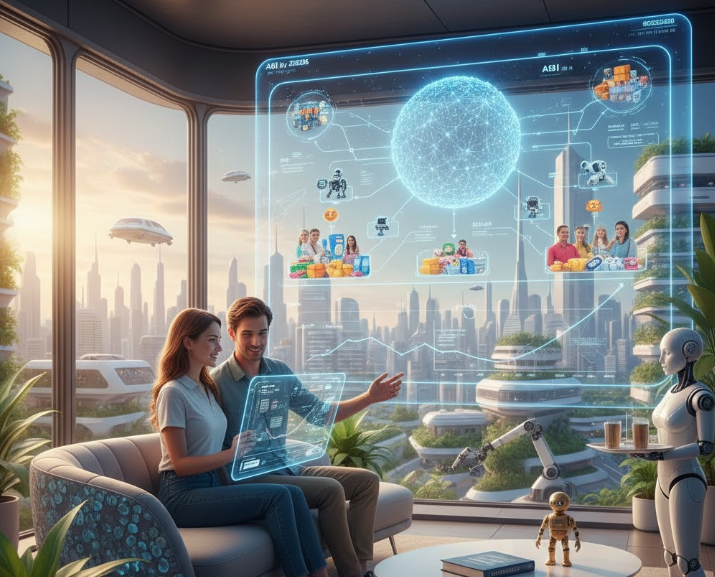
As we move into 2026, the concept of the AI Singularity is shifting from science fiction to a core consideration for financial planning. With artificial intelligence advancing at an exponential rate, traditional methods of saving and investing are being challenged. Understanding how a post-AGI (Artificial General Intelligence) economy functions is essential for anyone looking to secure their future in an era of rapid automation and demonetization.
📌 Deep Dive: Wealth Dynamics in the Age of Automation
Summary: As AI continues to reshape the global economy, the mathematical divide between labor-based income and capital-based wealth is accelerating. This video explores the fundamental mechanics of wealth concentration and why understanding these mathematical principles is vital for navigating a post-AGI financial landscape.
How the AI Singularity Changes Traditional Financial Planning
For decades, financial planning has been based on a simple premise: work, save a portion of your income, invest it in the market, and live off the growth during retirement. However, the AI Singularity—the point where AI exceeds human intelligence—threatens to decouple labor from value.
As of 2026, we are seeing the early stages of demonetization. This occurs when AI and robotics reduce the cost of goods and services to near zero by removing the need for expensive human labor. In this scenario, the goal of retirement shifts from accumulating a specific dollar amount to ensuring access to “Universal High Services.”
- Labor vs. Capital: When AI can perform tasks more efficiently than humans, the “value” of a traditional salary may decrease.
- Purchasing Power: If AI makes products significantly cheaper, you may need less “saved” capital than previously thought to maintain a high standard of living.
- Asset Shifts: Traditional stocks may behave differently as companies transition from human-centric to AI-centric productivity models.
Is Traditional Retirement Saving Still Necessary?
A common question emerging in 2026 is whether individuals should continue contributing to 401(k)s or IRAs if AI is expected to provide an abundance of resources. The short answer remains: Yes, but with a strategy for flexibility.
While many experts predict a future of “Universal High Stuff and Services” (UHSS), the transition period—often called the “bumpy ride”—could last years or even decades. During this phase, personal capital remains your primary safety net.
Expert Insight: According to the IMF’s analysis on AI’s promise for the global economy, the rapid integration of AI is expected to significantly boost global productivity, potentially altering the long-term value of traditional labor-based savings.
Why You Should Keep Saving:
- Transition Security: There is no guarantee of exactly when a post-scarcity economy will arrive.
- Asset Ownership: Owning the “means of production” (like shares in AI and robotics companies) ensures you benefit from the productivity boom.
- Regulatory Uncertainty: Governments are still debating how to tax AI-driven wealth and distribute it to the public.
Comparing the Old Economy vs. The AI-Driven Economy
The shift from a human-labor economy to an AI-productivity economy involves several fundamental changes in how money and value work.
| Feature | Traditional Economic Model | AI-Driven Singularity Model |
| Primary Cost Driver | Human labor and expertise | Electricity, compute, and raw materials |
| Growth Trend | 2–3% annual GDP growth | High double-digit productivity growth |
| Inflation/Deflation | Controlled inflation (approx. 2%) | Massive productivity-led deflation |
| Retirement Goal | Personal capital accumulation | Access to automated services & goods |
| Key Risk | Market volatility and outliving savings | Alignment of AI and social stability |
Economic Context: The World Economic Forum (WEF) highlights that as AI revolutionizes financial markets, the shift from scarcity to a productivity-led model will require a fundamental rethink of asset allocation and wealth distribution.
The Timeline: From AGI to Superintelligence
Staying informed requires monitoring the technical milestones that signal the approaching Singularity. In 2026, the timeline has compressed significantly:
- AGI (Artificial General Intelligence): AI that can match human cognitive performance across all domains. Many industry leaders project this milestone to be reached by late 2026 or 2027.
- ASI (Artificial Superintelligence): Intelligence that vastly surpasses all human brains combined. Projections suggest this could occur by 2030 due to recursive self-improvement (AI rewriting its own code to get smarter).
- Robotic Integration: The mass production of humanoid robots aims to scale labor indefinitely, further driving down the cost of living.
Technical Milestone: Industry reports from PANews regarding Elon Musk’s 2026 projections suggest that the achievement of AGI will mark a “singularity” point, where the cost of intelligence effectively drops to near-zero.
Common Mistakes in AI-Era Financial Planning
As the landscape shifts, many people fall into traps based on outdated information. Avoiding these mistakes can help you stay resilient.
- Ignoring Automation Risks: Assuming a “safe” professional job (like law or accounting) is immune to AI displacement.
- Over-Leveraging in High-Cost Areas: Buying expensive real estate in areas where the value is tied solely to proximity to human-led offices.
- Underestimating Deflation: Failing to realize that the “number” in your bank account matters less than what that number can buy in a world of cheap goods.
- Stopping Education: Thinking that a degree earned 10 years ago will remain relevant. Continuous AI literacy is the new “gold standard” for job security.
Frequently Asked Questions (FAQ)
What is the “demonetization of labor”?
This is a process where AI and robots take over tasks previously done by humans, causing the cost of that labor—and the resulting products—to drop toward the cost of electricity and hardware.
Will AI cause hyper-inflation or deflation?
Most economists specializing in AI predict massive deflation for goods and services because productivity will skyrocket. However, if the money supply is increased too rapidly by governments to compensate for job losses, we could see currency volatility.
How should I invest my money right now?
Focus on “equity in the future.” This often includes companies leading the AI, robotics, and energy sectors. However, diversification remains vital as we don’t yet know which specific companies will dominate the Singularity.
Is Universal Basic Income (UBI) inevitable?
While not guaranteed, many experts believe some form of UBI or “Universal High Services” will be necessary as AI replaces a significant percentage of traditional jobs.
What are the biggest risks of the Singularity?
The primary risks include “AI Alignment” (ensuring AI goals match human values) and the social instability that may occur during the transition as the job market is disrupted.
Further Reading: For a deeper look at how professional planners are adapting to these changes, refer to the CFP Board’s report on AI in financial planning.
Practical Takeaway: Preparing for an Uncertain Future
The journey toward the AI Singularity is not a reason for financial panic, but it is a call for adaptability. The traditional advice of “save and wait” is evolving into “learn and adapt.”
To prepare effectively, focus on maintaining a flexible financial structure, investing in your own ability to use AI tools, and keeping a close eye on technological milestones. While the end goal may be a world of abundance, the most successful people in the coming decade will be those who bridge the gap between the old world of scarcity and the new world of AI-driven productivity.