
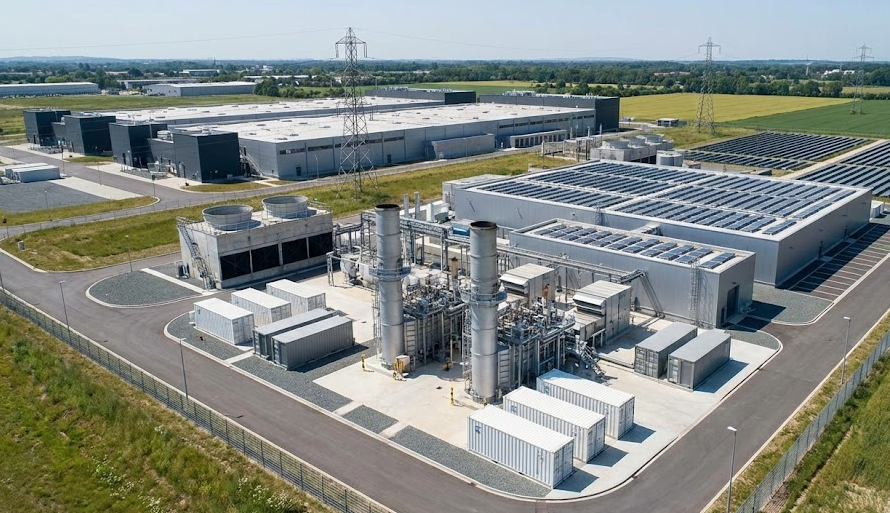
This article is a comprehensive synthesis of personal research and technical study regarding next-generation data center infrastructure. It aims to structure complex industry trends and technical data for educational purposes and strategic analysis.
Opening Summary
In an era defined by the explosive growth of artificial intelligence and high-performance computing, data center availability is no longer constrained by server hardware, but by access to reliable electricity. As traditional utility grids reach capacity, securing independent power is now a critical competitive advantage. This skyscraper guide provides an exhaustive analysis of data center categories, evaluates the strategic imperative for on-site power generation, and compares diverse solutions from gas turbines and fuel cells to BESS, defining the future of digital infrastructure.
The Evolution of Digital Infrastructure and the Energy Paradigm Shift
The role of the data center has fundamentally transformed. Once primarily a repository for digital storage, the modern data center has evolved into a dynamic computational engine driving the global economy. The rise of High-Performance Computing (HPC) and the training of vast Large Language Models (LLMs) for artificial intelligence have precipitated an unprecedented surge in power density and total energy demand.
This exponential growth has placed an unsustainable strain on traditional, centralized utility grids globally. In major digital hubs, the grid is not just stressed; it has reached a breaking point. The critical bottleneck for deploying new digital services is no longer the availability of fiber optics or silicon, but the availability of megawatts. Consequently, the strategic focus for data center operators has shifted from merely maximizing server rack density to securing high-availability, independent “Power Sovereignty.”
A Deep Dive into Data Center Categories
To understand the energy challenges and solutions, one must first delineate the landscape of modern data centers. These facilities are classified based on their scale, operational objectives, and tenancy models, each with distinct power profiles.
1. Hyperscale Data Centers
Owned and operated by global technology giants such as Amazon Web Services (AWS), Google, and Microsoft, these facilities are the massive engines of the cloud. A single hyperscale campus typically houses tens of thousands of servers and can consume anywhere from 50MW to over a gigawatt of power. Due to their immense scale and continuous operation, hyperscalers are the industry leaders in optimizing Power Usage Effectiveness (PUE). They are often the first to adopt advanced microgrid architectures and innovate in liquid cooling technologies to manage extreme thermal loads.
2. Colocation Data Centers
Colocation providers, such as Equinix and Digital Realty, function as digital landlords. They build the physical infrastructure—the building, power, and cooling—and rent space to multiple tenants, ranging from enterprises to cloud service providers. The primary challenge for colocation facilities is managing “multi-tenancy.” They must provide flexible and scalable power distribution systems that can accommodate the varying power density requirements of diverse customers while ensuring precise billing and Service Level Agreements (SLAs).
3. Enterprise Data Centers
These facilities are owned and operated by a single organization, typically large corporations in sectors like finance, healthcare, or manufacturing, to manage their proprietary data and applications. While the trend has moved toward cloud migration, many enterprises retain on-site data centers for reasons of absolute data sovereignty, security compliance, or specific legacy application needs. Their power strategies are often conservative, prioritizing maximum reliability and uptime over cutting-edge efficiency.
4. Edge Data Centers
Located geographically close to the end-user, edge data centers are designed to minimize latency for real-time applications such as autonomous driving, 5G network services, and industrial IoT. While individual edge sites are small—often consuming less than 1MW—their distributed nature presents unique challenges. They require compact, low-maintenance, and remotely manageable power solutions, making technologies like fuel cells and smaller battery energy storage systems highly attractive.
[Table] Comparative Analysis of Data Center Types
| Category | Primary Operator | Strategic Objective | Power Capacity Range | Key Energy Focus |
| Hyperscale | Global Tech Giants (CSPs) | Cloud Computing & AI Training | Ultra-High (50MW – 1GW+) | PUE Optimization, RE100 Goals, Custom Microgrids |
| Colocation | Infrastructure Specialists | Multi-Tenant Infrastructure Rental | High (10MW – 50MW) | Scalability, Flexible Power Distribution, SLAs |
| Enterprise | Large Corporations, Banks | Data Security & Internal Operations | Medium (1MW – 10MW) | Reliability, Security Compliance, Cost Control |
| Edge | Telcos, Content Providers | Latency Reduction for Real-Time Services | Low (< 1MW per site) | Distributed Management, Compact Footprint, Low Maintenance |
The Strategic Imperative: Why Choose On-site Power Over the Grid?
Historically, connecting to the local utility grid was the default and most cost-effective power strategy. Today, however, leading data center operators are increasingly choosing to invest significant capital into building their own on-site power plants. This strategic pivot is driven by three critical business imperatives.
1. The “Time-to-Market” Advantage
In premier data center markets across North America and Europe, including Northern Virginia, Dublin, and Amsterdam, the waiting period for a new large-scale utility grid connection has ballooned to an average of 5 to 8 years due to transmission constraints and regulatory hurdles. In the fast-moving digital economy, this delay is untenable. An on-site power generation facility, utilizing modular gas turbines or fuel cells, can be designed, permitted, and commissioned in approximately 18 to 30 months. This ability to bypass grid queues allows operators to bring AI services to market years ahead of competitors dependent on utility timelines.
2. Uncompromising Reliability and Power Sovereignty
Aging utility grids are increasingly susceptible to failures from extreme weather events, cyber threats, and peak load instability. By operating an on-site microgrid in “island mode”—completely independent of the utility connection—data center operators gain full control over their power quality and availability. This sovereignty ensures 99.999% uptime for mission-critical workloads, mitigating the immense financial and reputational risks of outages.
3. Efficiency Through Trigeneration (CCHP)
Grid electricity is inherently inefficient due to generation and transmission losses. On-site generation, particularly with gas turbines, unlocks the potential for Combined Cooling, Heat, and Power (CCHP) or Trigeneration. The high-temperature exhaust heat from the turbine is captured and directed to absorption chillers, which produce chilled water for server cooling without consuming additional electricity. This process can lower the facility’s PUE to near 1.1 while significantly reducing operational expenses (OPEX).
Market Insights: Global Investment Banks Confirm the Shift
Leading global financial institutions have published authoritative research confirming that grid constraints are the primary catalyst for the adoption of on-site power solutions in the data center sector.
- Goldman Sachs: In their report, “Generational Growth: AI, Data Centers and the Coming US Power Surge,” analysts project that data centers could consume up to 8% of total US electricity by 2030. The report emphasizes that renewable energy and battery storage alone are insufficient to meet this baseload demand, identifying natural gas as a critical transition fuel for on-site generation to bridge the power gap.
- Morgan Stanley: Their analysis in “Power Plays in the AI Era” highlights that as grid connection delays intensify, “Behind-the-Meter” (on-site) power solutions are becoming a key determinant of data center asset value. The firm argues that technologies enabling faster time-to-market, such as fuel cells and modular turbines, will see significant market traction.
Technical Comparison: Grid Connection vs. On-site Microgrid
The choice between relying on the utility grid and implementing an on-site microgrid involves a complex trade-off between capital investment, operational control, and speed of deployment.
| Feature | Utility Grid Connection | On-site Microgrid Generation |
| Time-to-Market | 5–8 Years (Significant delays common) | 1.5–2.5 Years (Rapid deployment) |
| Reliability | Dependent on external grid stability | High; Independent “Island Mode” capability |
| Energy Efficiency | Subject to generation & transmission losses | High via waste heat recovery (Trigeneration) |
| Carbon Strategy | Dependent on regional utility fuel mix | Direct control via hydrogen blending or CCUS |
| Initial Investment (CAPEX) | Lower (primarily substation/transformer) | High (turbines, fuel cells, BESS, infrastructure) |
| Operational Cost (OPEX) | Subject to volatile utility pricing tariffs | Dependent on fuel commodity prices & O&M |
Analyzing Diverse On-site Power Generation Solutions
A robust on-site power strategy rarely relies on a single technology. Instead, operators are adopting hybrid microgrid architectures that combine various generation and storage assets to optimize for reliability, cost, and sustainability.
1. Gas Turbine Clusters
Modular aeroderivative gas turbines serve as the preferred solution for large-scale base-load power. They offer high power density, rapid ramp-up capabilities, and high exhaust temperatures ideal for trigeneration applications. Their modularity allows for scalable N+1 redundancy configurations.
2. Fuel Cells
Fuel cells generate electricity through an electrochemical process rather than combustion, resulting in ultra-low noise and vibration profiles. This makes them ideal for edge data centers located in dense urban environments. They offer high electrical efficiency and are inherently “hydrogen-ready,” providing a clear path to future decarbonization.
3. Renewable Energy (Solar & Wind)
While essential for achieving corporate RE100 and ESG goals, solar and wind are intermittent resources. They cannot be relied upon as the primary power source for 24/7 mission-critical data center operations without massive, cost-prohibitive storage. They are best utilized as supplemental power to offset grid consumption.
4. Battery Energy Storage Systems (BESS)
BESS, typically using lithium-ion technology, act as the critical stabilizing “glue” in a microgrid. They provide instantaneous power response to smooth out the sharp load spikes characteristic of AI training workloads and bridge the gap during the seconds it takes for generators to start up. They also enable peak-shaving strategies to reduce energy costs.
5. Diesel Generators
Diesel gensets are the traditional standard for backup power due to their low initial cost and proven reliability. However, due to significant emissions of nitrogen oxides ($NO_x$) and particulates, along with increasingly strict environmental regulations, their role is being relegated strictly to emergency last-resort standby, rather than active power management.
[Table] Comparative Matrix of On-site Power Technologies
| Technology | Primary Advantage | Primary Disadvantage | Optimal Use Case |
| Gas Turbines | High power density, excellent trigeneration potential | Fossil fuel dependence, requires maintenance | Hyperscale base-load power |
| Fuel Cells | Low noise/vibration, high efficiency, hydrogen-ready | High initial CAPEX, requires fuel supply infrastructure | Urban and Edge data centers |
| Renewables (Solar/Wind) | Zero carbon emissions, low operational cost | Intermittent generation, large space footprint | ESG supplement, not primary power |
| BESS (Batteries) | Instantaneous response, grid stabilization, peak shaving | Limited duration capacity, fire risk management | Microgrid stability, short-term bridge power |
| Diesel Generators | Low CAPEX, proven long-term reliability | High emissions, regulatory restrictions, noise | Emergency standby only |
Data Center On-site Power Verification Checklist
Before committing to an on-site power strategy, stakeholders must conduct rigorous due diligence across several critical vectors.
- Fuel Infrastructure Availability: Verify proximity to high-pressure natural gas pipelines with sufficient capacity or assess the feasibility of on-site LNG storage and vaporization facilities.
- Environmental & Permitting Compliance: Conduct a thorough analysis of local air quality regulations, specifically focusing on $NO_x$, $CO$, and particulate matter emissions limits for continuous operation equipment, as well as noise ordinances.
- Integrated Microgrid Controls: Ensure the presence of a sophisticated Power Management System (PMS) capable of millisecond-level synchronization between diverse assets like gas turbines, fuel cells, and BESS to maintain stability during load transients.
- Lifecycle Maintenance Strategy: Secure comprehensive Long-Term Service Agreements (LTSA) with original equipment manufacturers (OEMs) to guarantee parts availability, performance guarantees, and high availability over the asset’s 20-year lifespan.
The Senior Editor’s Perspective: The Era of Power Sovereignty
The data center industry has entered a new paradigm where power availability acts as the primary constraint on growth. Waiting five years for a utility connection is tantamount to ceding market leadership in the fast-paced AI sector. The future belongs to operators who embrace “Power Sovereignty”—the strategic control over their energy destiny.
Successful data centers of the future will be defined by their hybrid microgrids, intelligently integrating base-load gas turbines or fuel cells with fast-response BESS and supplemental renewables. For Engineering, Procurement, and Construction (EPC) firms, the opportunity lies in evolving from facility builders to integrated energy solution partners. In this new era, the most critical asset for digital infrastructure is no longer just the data itself, but the reliable, independent power that brings that data to life.
Disclaimer: All product names, logos, and brands are property of their respective owners. This site is not affiliated with or endorsed by any of the companies mentioned. The technical analysis is based on publicly available data and personal insights.