
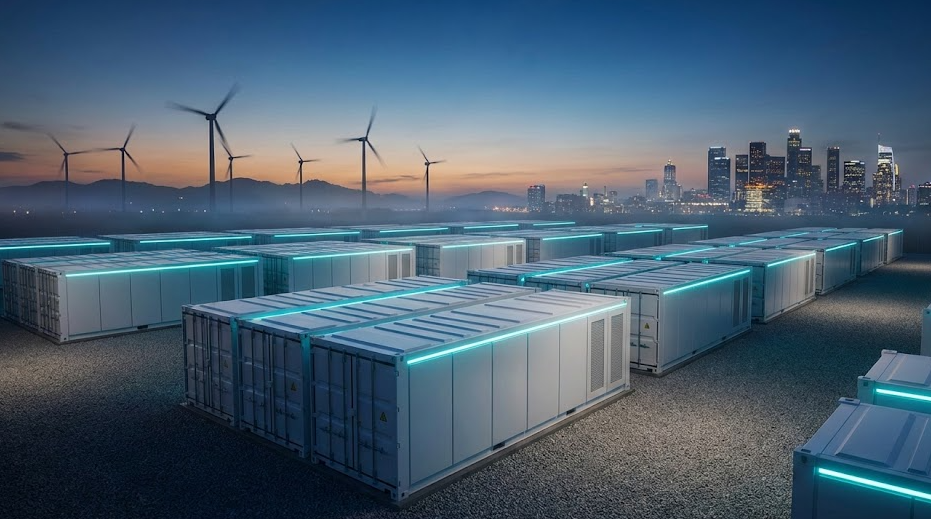
Battery Energy Storage Systems (BESS) are more than just “large batteries.” They are the holy grail of modern infrastructure—solving the intermittency of renewables, stabilizing grid frequency, and generating revenue through arbitrage.
This master guide covers the entire ecosystem: from foundational technology and specifications to rigorous market verification using reports from BloombergNEF, Lazard, and Goldman Sachs. It further dissects the Global Value Chain, identifying key Tier-1 players and investment trends across the US, Europe, and Australia.
1. The Strategic Rationale: Why BESS, Why Now?
The global energy market is undergoing a once-in-a-century paradigm shift from “Centralized Fossil Generation” to “Decentralized Renewable Generation.” However, solar and wind power suffer from a critical flaw: Intermittency. They cannot produce power on demand.
BESS is the only proven, scalable solution to bridge this gap.
1.1 The Three Pillars of Value
- Grid Stabilization (Frequency Regulation): When demand spikes or generation drops, BESS responds in milliseconds (ms) to maintain grid frequency (Hz) and voltage. This capability is critical for preventing blackouts, as detailed in the FERC Order 841 which mandates storage participation in wholesale markets.
- Time Shifting & Arbitrage: Storage allows operators to buy power when it is cheapest (or when solar output is high) and sell it when prices peak. This “buy low, sell high” mechanism is the core revenue driver.
- Preventing Curtailment: It captures renewable energy that would otherwise be wasted (curtailed) due to grid congestion, preserving the asset value of solar/wind farms.
2. Technical Deep Dive & Critical Specifications
To evaluate a project or company, one must understand the system architecture. A BESS is not just a pile of cells; it is a highly integrated software-hardware complex.
2.1 Core Components
- Battery Modules/Racks: The chemical reservoir of energy. Thousands of cells connected in series/parallel.
- BMS (Battery Management System): The “Nervous System.” It monitors cell voltage, current, and temperature to prevent thermal runaway.
- PCS (Power Conversion System): The “Heart.” A bi-directional inverter that converts DC (stored in batteries) to AC (used by the grid).
- EMS (Energy Management System): The “Brain.” Software algorithms that decide when to charge or discharge. Modern EMS uses AI to predict market prices.
2.2 Key Specs for Decision Making
- Energy Capacity (MWh): Total energy stored. Determines “how long” the system can discharge.
- Power Capacity (MW): Maximum instantaneous output. Determines “how big” of a load it can support.
- C-Rate: The ratio of Power to Energy.
- 1C: Fully charges/discharges in 1 hour.
- 0.5C: 2-hour duration (Energy-density focused).
- 4C: 15-minute duration (High-power/Frequency regulation focused).
- DoD (Depth of Discharge): The percentage of battery capacity actually used, typically capped at 80–90% to extend cycle life.
3. Chemical Typology: Choosing the Right Cell
According to the IEA’s Global EV Outlook and Battery Report, the market has bifurcated based on use cases.
3.1 Lithium Iron Phosphate (LFP) – The Market Standard
- Characteristics: Uses no cobalt or nickel. Lower energy density but significantly higher safety (thermal stability) and longer cycle life.
- Dominance: Currently captures >80% of the stationary storage market. The standard for 2–4 hour storage.
- Key Players: CATL, BYD (China).
3.2 Nickel Manganese Cobalt (NMC/NCM) – The Density King
- Characteristics: High energy density. Capable of storing more energy in a smaller footprint.
- Use Case: Ideal for space-constrained urban sites or EVs where weight matters.
- Key Players: LG Energy Solution, Samsung SDI (Korea).
3.3 Redox Flow Batteries (RFB) – The Long-Duration Future
- Characteristics: Energy is stored in liquid electrolyte tanks. Capacity is decoupled from power; to store more energy, simply use bigger tanks. Zero fire risk.
- Use Case: Long Duration Energy Storage (LDES) requiring 8 to 24+ hours of discharge. Refer to the Long Duration Energy Storage Council for detailed technology mapping.
4. Market Verification: Institutional Analysis
The following analysis is based on top-tier investment bank and research firm reports.
4.1 BloombergNEF (BNEF): The Price Revolution
- Core Thesis: “Battery pack prices falling below $100/kWh is the trigger.”
- Insight: According to BloombergNEF’s Energy Storage Outlook, the plummeting cost of LFP batteries is accelerating “Grid Parity.” Storage is becoming cheaper than building new gas peaker plants, even without subsidies in some regions.
4.2 Lazard: Levelized Cost of Storage (LCOS)
- Core Thesis: “Solar + Storage Hybrid is the economic winner.”
- Insight: Lazard’s Levelized Cost of Storage Analysis (LCOS+) confirms that the lifecycle cost of 4-hour Lithium-ion systems has dropped significantly, making them the most cost-effective solution for replacing fossil fuel flexibility services.
4.3 Goldman Sachs: The Policy Supercycle
- Core Thesis: “The IRA is a game-changer for US Storage.”
- Insight: The Inflation Reduction Act (IRA) introduced the Investment Tax Credit (ITC) for “Stand-alone Storage,” fundamentally improving project IRR. Goldman Sachs Insights: The Great Battery Race highlights the shift from hardware margins to software/integration value.
5. Global Market Landscape: The Big Three
🇺🇸 United States: The Growth Engine
- Driver: The Inflation Reduction Act (IRA) provides a 30-40% Investment Tax Credit (ITC).
- Trend: California (CAISO) and Texas (ERCOT) lead the world. In CAISO, batteries now frequently provide more power than nuclear plants during evening peak hours. The market is shifting toward larger, stand-alone utility-scale projects.
🇦🇺 Australia: The Grid Lab
- Driver: World’s highest rooftop solar penetration creates a massive “Duck Curve.”
- Trend: Following the success of the Tesla Hornsdale Power Reserve, Australia is aggressively replacing retiring coal plants with “Big Batteries” to provide Frequency Control Ancillary Services (FCAS).
🇪🇺 Europe: Security & Decarbonization
- Driver: REPowerEU Plan. The need to reduce reliance on Russian gas and integrate North Sea wind.
- Trend: The UK is the largest mature market for frequency response. Germany is seeing a boom in residential BTM (Behind-the-Meter) storage paired with solar.
6. The BESS Value Chain & Key Players
The industry value chain is distinct: Upstream (Cells) → Midstream (Modules/PCS) → Downstream (Integration/Software).
6.1 Upstream: Battery Cell Manufacturers
The “Engine” makers. Dominated by scale and cost efficiency.
- CATL (China): The undisputed global leader. Suppliers of LFP cells to Tesla, Fluence, and nearly every major integrator.
- LG Energy Solution / Samsung SDI (Korea): The alternative to Chinese supply chains. Crucial for US/EU projects requiring “Non-FEOC” (Foreign Entity of Concern) compliant batteries.
6.2 Downstream: System Integrators (SI) [High Growth Sector]
They package the cells, PCS, cooling, and software into a turnkey solution.
- Tesla (USA): The Megapack is the industry standard. Their vertical integration gives them massive speed and cost advantages.
- Fluence (USA): A JV between Siemens and AES. The pure-play global leader with deep data assets and a technology-agnostic approach.
- Sungrow (China): Leveraging their #1 position in solar inverters to dominate the PCS and integrated storage market.
6.3 Operation: Software & EMS (The Brains)
As hardware commoditizes, value shifts here.
- Stem Inc (USA): Focuses on AI-driven energy optimization (Athena platform) for enterprise customers.
- AutoBidder (Tesla): An algorithmic trading platform that allows BESS owners to monetize their assets in wholesale markets automatically.
7. Visual Data: Comparative Analysis
[Table 1] Comparison of Storage Technologies
| Feature | Lithium Iron Phosphate (LFP) | Nickel Manganese Cobalt (NMC) | Vanadium Redox Flow (VRFB) |
| CAPEX | Low (Most competitive) | Medium/High | High (Requires scale) |
| Safety | High (Thermal stability) | Medium (Thermal runaway risk) | Very High (Water-based) |
| Cycle Life | 4,000 ~ 6,000+ | 2,000 ~ 3,000 | 10,000+ (Unlimited) |
| Best For | Grid Standard (2-4 hrs) | EVs, Space-constrained | Long Duration (8 hrs+) |
8. Senior Editor’s Outlook: The Future View
“Post-2026, the battle moves from Hardware to Software and Duration.”
- Commoditization of LFP: LFP cells are becoming a commodity. The differentiator is no longer the cell, but the EMS. Who can bid smarter in the market?
- Rise of VPPs (Virtual Power Plants): The aggregation of thousands of residential and commercial batteries into a single dispatchable node will become a primary grid asset, as analyzed by RMI (Rocky Mountain Institute).
- LDES (Long Duration Energy Storage): As renewable penetration exceeds 50%, 4-hour lithium batteries will hit a wall. Technologies offering 8-100 hours of storage will see a surge in investment.
9. FAQ (People Also Ask)
Q1. How do non-Chinese battery makers compete with CATL’s pricing?
A. Companies like LG and Samsung SDI compete on quality, density, and crucially, geopolitical compliance. For US projects seeking IRA subsidies, non-Chinese supply chains are often mandatory.
Q2. What is the biggest risk to BESS projects today?
A. It is not technology, but Supply Chain and Interconnection. Specifically, the shortage of High Voltage Transformers can delay projects by 12–24 months.
Q3. What happens to the batteries at end-of-life?
A. A secondary market for UBESS (Used Battery ESS) is emerging. Eventually, recycling is mandated to recover Lithium, Cobalt, and Nickel, creating a circular economy.
10. Implementation Checklist
Before investing in or commissioning a project, verify the following:
- [ ] Interconnection Capacity: Confirmed “Hosting Capacity” availability at the local substation?
- [ ] Safety Compliance: Adherence to NFPA 855 (Standard for the Installation of Stationary Energy Storage Systems) and UL 9540A fire test results.
- [ ] Warranty Terms: Check for “Throughput” guarantees (total energy cycled) rather than just calendar years.
- [ ] Revenue Stacking: Is the financial model robust? Does it combine Capacity Markets, Arbitrage, and Ancillary Services?
Disclaimer: All product names, logos, and brands are property of their respective owners. This site is not affiliated with or endorsed by any of the companies mentioned. The technical analysis is based on publicly available data and personal insights.