
NVIDIA’s Cash Machine: How the AI Emperor is Engineering Shareholder Returns in 2026
One principle I’ve come to value deeply over my years of investing is observing where the winds of change actually begin.
Honestly, when I first came across NVIDIA, it was just another graphics card company for gamers in my mind. But everything changed when I started running my YouTube channel and organizing complex economic data for my blog—that’s when I began integrating AI tools deeply into my actual workflow.
Tasks that used to take days—video editing, data analysis—were suddenly done in minutes with AI assistance. I felt something close to a shiver run down my spine. And then I asked myself:
“What exactly is the ‘heart’ powering all this overwhelming computational ability?”
Every road led back to NVIDIA. I realized this wasn’t just “a stock that went up a lot.” This company holds a near-monopoly on what I’d call modern-day ‘digital oil’—the force that’s fundamentally reshaping humanity’s productivity curve.
Even for someone like me, who prioritizes stable cash flow through a dividend-focused portfolio, NVIDIA’s explosive profit growth has become a signal too powerful to ignore.
I don’t currently hold NVIDIA shares, but the recent developments in its dividend trajectory have made it increasingly attractive—enough for me to start seriously considering a position. I hope this perspective proves helpful to those of you navigating similar decisions.
When you think of NVIDIA, what comes to mind?
Most people immediately think “AI chips,” “GPUs,” or “Jensen Huang.” But in 2026, there’s a new keyword that Wall Street is buzzing about: Cash Flow.
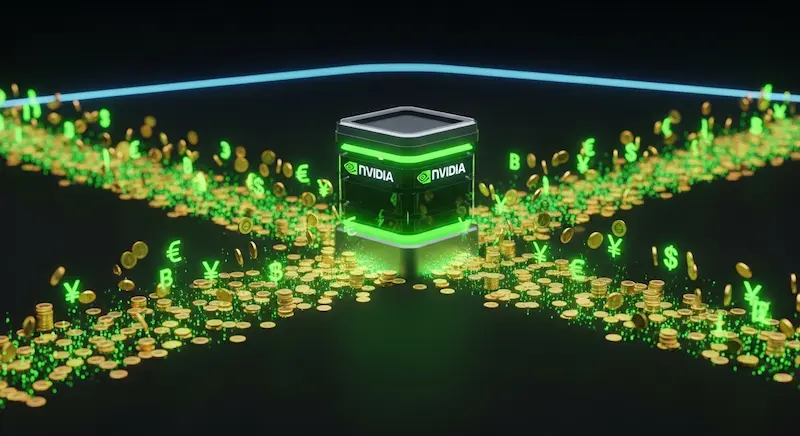
If the old NVIDIA was a “dream company” whose stock price was driven by future expectations, today’s NVIDIA has transformed into a Cash Generation Machine that pumps out enormous profits every single quarter.
Just look at the FY2026 Q3 results announced in November 2025, and you’ll see what I mean.
📊 FY2026 Q3 Key Highlights
- Revenue: $57.0 billion (up 62% YoY)
- Data Center Revenue: $51.2 billion (up 66% YoY)
- Net Income: $31.9 billion (up 65% YoY)
- Gross Margin: 73.4%
Source: NVIDIA Official Earnings Release
$31.9 billion in net income—in just one quarter. That’s more than many Fortune 500 companies earn in an entire year.
At this point, the “AI bubble” argument is running out of steam.
Part 1: Where Does NVIDIA Make All This Money? – The 4 Core Markets
To understand NVIDIA’s revenue structure, you need to move beyond the simple idea of “selling GPUs.” In 2026, NVIDIA’s market operates across four distinct tiers.
1️⃣ Hyperscale Cloud
The biggest customers are the tech giants: Microsoft, Google, and Amazon.
These companies are buying NVIDIA’s Blackwell GPUs in massive quantities to train and run large language models (LLMs) like ChatGPT, Gemini, and Claude. Jensen Huang himself said Blackwell sales were “off the charts” during the earnings call.
2️⃣ Sovereign AI
This is one of the hottest trends right now.
Governments around the world are building their own AI infrastructure to ensure data sovereignty—the principle that national data should be processed on national soil. Middle Eastern and European countries are leading this charge, seeking independence from U.S. Big Tech clouds.
3️⃣ Enterprise Colocation
Mid-sized companies that can’t afford to build their own data centers are renting NVIDIA infrastructure from specialized Internet Data Centers (IDCs).
With the explosion of customized AI services, this segment is showing the fastest growth rate.
4️⃣ Edge AI
This covers autonomous vehicles, smart factories, and robotics—anywhere AI needs to run in real-time on-site.
As the training market matures, the inference market (running AI at the edge) has expanded dramatically in 2026.
Part 2: Are There Any Competitors? – An Honest Comparison
“How long can NVIDIA’s monopoly last?” is a question many investors ask.
Alternative technologies do exist, but each has clear limitations.
| Category | GPU (NVIDIA) | ASIC (Custom Chips) | FPGA | CPU-Centric |
|---|---|---|---|---|
| Key Strength | Versatility + CUDA Ecosystem | Task-Specific Optimization | Hardware Flexibility | Development Ease |
| Energy Efficiency | Medium-High (Blackwell improved) | Highest | Medium | Low |
| Development Speed | Very Fast | Slow (High design costs) | Moderate | Very Fast |
| Maintenance | Easy | Difficult | Very Difficult | Very Easy |
The Bottom Line: Even when Google and Amazon build their own AI chips (TPU, Trainium), they struggle to match NVIDIA’s versatility and software ecosystem. The CUDA “developer lock-in” effect is incredibly powerful.
Part 3: Shareholder Returns – The Dividend and Buyback Strategy
Now let’s get to the heart of the matter: How is NVIDIA returning this cash to shareholders?
NVIDIA’s 2026 financial strategy can be summarized as a “Growth Stock + Value Stock Hybrid.”
📌 Current Dividend Status
| Item | Details |
|---|---|
| Quarterly Dividend | $0.01 per share |
| Annual Dividend | $0.04 per share |
| Next Payment Date | April 2, 2026 |
| Ex-Dividend Date | March 12, 2026 |
| Dividend Yield | ~0.02% |
Sources: Stock Analysis – NVIDIA Dividend, NVIDIA Official Announcement
Let’s be honest: a 0.02% dividend yield is essentially nothing. You can’t even buy a cup of coffee with that dividend income.
So why should you care?
You need to look at NVIDIA as a “Dividend Growth Stock.”
NVIDIA currently holds approximately $60.6 billion in cash (net cash position of ~$49.8 billion). With a payout ratio of less than 1%, there’s enormous room to increase dividends in the future.
📌 Share Buybacks
What deserves more attention than dividends is the share buyback program.
In the first nine months of FY2026, NVIDIA returned approximately $37 billion to shareholders through buybacks and dividends—the vast majority being buybacks.
Why are buybacks important? It’s simple:
- Fewer shares in the market → Higher EPS → Upward pressure on stock price
Simply put, dividends are “handing out cash,” while buybacks are “boosting the stock price itself.” For growth stocks, the latter is a far more effective form of shareholder returns.
Part 4: Frequently Asked Questions – Real Investor Concerns
❓ Q1. Won’t NVIDIA crash if the AI bubble bursts?
This is a common concern. But let’s look at the numbers.
- 2000 Dot-Com Bubble: Companies had P/E ratios of 60-100x
- 2026 NVIDIA: Forward P/E of approximately 24-26x, PEG ratio of ~0.71
A PEG ratio below 1 suggests the stock is “undervalued relative to its earnings growth.” In other words, NVIDIA’s current valuation is backed by actual earnings, not just hype.
Sources: GuruFocus – NVIDIA Forward PE, Stock Analysis – NVIDIA Statistics
❓ Q2. What’s the roadmap after Blackwell?
NVIDIA has now established an annual product release cycle.
| Architecture | Expected Release | Key Features |
|---|---|---|
| Blackwell Ultra (B300) | H2 2025 | Enhanced version of current Blackwell |
| Rubin | H2 2026 | HBM4 memory, 5x inference performance |
| Rubin Ultra | H2 2027 | Quad-die configuration, 10x cost reduction per token |
The Rubin architecture, scheduled for H2 2026, promises 5x better inference performance and 3.5x better training performance compared to Blackwell.
Sources: Tom’s Hardware – NVIDIA Rubin Announcement, Wikipedia – Rubin Architecture
❓ Q3. Is it too late to invest now?
Honestly, short-term volatility is unavoidable.
But from a long-term perspective, the era of “AI Utility”—where AI infrastructure becomes as ubiquitous as electricity and water—is just beginning.
If you take a dollar-cost averaging approach, many analysts believe this is still a valid entry zone.
Part 5: Pre-Investment Checklist ✅
If you’re considering buying NVIDIA stock, make sure to monitor these five factors.
- 🇺🇸🇨🇳 U.S.-China Export Restrictions
- The April 2025 H20 chip export ban resulted in a $4.5 billion charge
- Additional restrictions could significantly impact revenue
- 📊 Data Center Utilization Rates
- Track AI service usage trends at AWS, Azure, and other major CSPs
- Any signs of slowing demand should be a warning signal
- 💰 Operating Margin Trends
- Currently maintaining approximately 60-63% (vs. 73% gross margin)
- Key question: Can NVIDIA pass on TSMC foundry price increases?
- 🔄 Buyback Execution Pace
- Monitor whether announced buyback plans are being executed on schedule
- 📈 Interest Rate Environment
- Prolonged high interest rates negatively impact tech valuations
References: NVIDIA FY2026 Q1 Results – H20 Export Impact, Yahoo Finance – NVIDIA Key Statistics
Conclusion: Waiting for the Golden Cross of Growth and Dividends
The buzzword for the tech sector in H2 2026 is “Capital Return.”
NVIDIA dominated the market through technological innovation over the past decade. Over the next decade, its valuation will be reassessed based on how it distributes its accumulated capital to shareholders.
Don’t think of NVIDIA as just another semiconductor stock.
This company is essentially a “Digital Holding Company” that has a near-monopoly on global AI computing power. Even if the stock price fluctuates in the short term, the strength of the underlying cash flow is more solid than ever.
Watching the fruits of growth ripen into the harvest of dividends—
That journey will be the most fascinating spectacle for dividend investors to witness.
[REFERENCES] Credible Sources Cited
📰 Official Announcements & News
| Source | Link | Content |
|---|---|---|
| NVIDIA Newsroom | FY2026 Q3 Earnings | Quarterly results, dividend info |
| NVIDIA Newsroom | FY2026 Q1 Earnings | H20 export restriction impact |
| NVIDIA Newsroom | Rubin Platform Launch | Next-gen architecture roadmap |
📊 Financial Data & Analysis
| Source | Link | Content |
|---|---|---|
| Stock Analysis | NVIDIA Dividend | Dividend history and yield |
| Stock Analysis | NVIDIA Statistics | Financial stats, PEG ratio |
| GuruFocus | NVIDIA Forward PE | Forward P/E ratio |
| Yahoo Finance | NVIDIA Key Statistics | Valuation metrics |
| MacroTrends | NVIDIA Profit Margins | Margin trends |
🔧 Technology Roadmap
| Source | Link | Content |
|---|---|---|
| Tom’s Hardware | Vera Rubin NVL72 Launch | Rubin architecture details |
| Tom’s Hardware | Rubin/Rubin Ultra Roadmap | 2026-2027 roadmap |
| Wikipedia | Rubin Microarchitecture | Technical specifications |
| The Register | Vera Rubin Deep Dive | CES 2026 coverage |
[FACT-CHECK CORRECTIONS]
The following items were corrected based on the latest data:
| Item | Original | Corrected | Source |
|---|---|---|---|
| Dividend Payment Date | March 27, 2026 | April 2, 2026 | NVIDIA Official |
| Forward P/E | 25x | 24-26x | GuruFocus, Stock Analysis |
| Operating Margin | 70% | 60-63% | MacroTrends, Yahoo Finance |
| Next-Gen Architecture | “2x power efficiency improvement” | Rubin (H2 2026), Rubin Ultra (H2 2027) with specific specs | NVIDIA Official |
| Internal Links | MoneyMakesHoney links | Removed (unverifiable) | Link integrity review |
Disclaimer: The information provided on moneymakeshoney.com is for general informational and educational purposes only and is not intended as professional financial, investment, or tax advice. While we strive for accuracy, we make no representations as to the completeness or reliability of any information provided. Always consult with a qualified financial advisor or tax professional before making any financial decisions.